

Pluribus Season 1 is an Apple TV+ science fiction post-apocalyptic series created by Vince Gilligan, the mind behind Breaking Bad and Better Call Saul.
With Gilligan, Jeff Frost, Diane Mercer, Allyce Ozarski, Gordon Smith & Alison Tatlock serving as executive producers, the show stars Rhea Seehorn as Carol Sturka, Karolina Wydra as Zosia, Carlos-Manuel Vesga as Manousos Oviedo, Miriam Shor as Helen L. Umstead, Samba Schutte as Koumba Diabaté, & Menik Gooneratne as Laxmi.
This is Gilligan and Seehorn’s second collaboration after Better Call Saul. Pluribus. Season 1 was released on November 7, 2025 on Apple TV+.
THIS REVIEW CONTAINS SPOILERS
Pluribus Season 1 Synopsis:
In a world overtaken by a mysterious wave of forced happiness, Carol Sturka, one of the immune few, must uncover what’s really going on – and save humanity from its artificial bliss.
Pluribus Season 1 Review:
Pluribus was my most anticipated show of 2025. Having loved both Breaking Bad and Better Call Saul, I had very high hopes for this one. Plus, it starred Rhea Seehorn, with Vince Gilligan serving as showrunner. Every piece of news that released only built my expectations a bunch.
While I did find the first couple of episodes a tad underwhelming, the direction that the show took really resonated with me. The hive mind concept wasn’t new to me, with even Rick & Morty having done an episode or two about it. However, Gilligan’s exploration of the same, touching upon ethical and moral dilemmas was thought-provoking.
We start out with romantasy author Carol Sturka (Rhea Seehorn) as she goes on a tour to promote her latest novel. Despite the crazy success and loving fanbase, she finds her own stories meaningless and base. Her agent and partner, Helen (Miriam Shor), encourages her to publish her dream novel, celebrating the success of her latest. However, those celebrations are cut short when
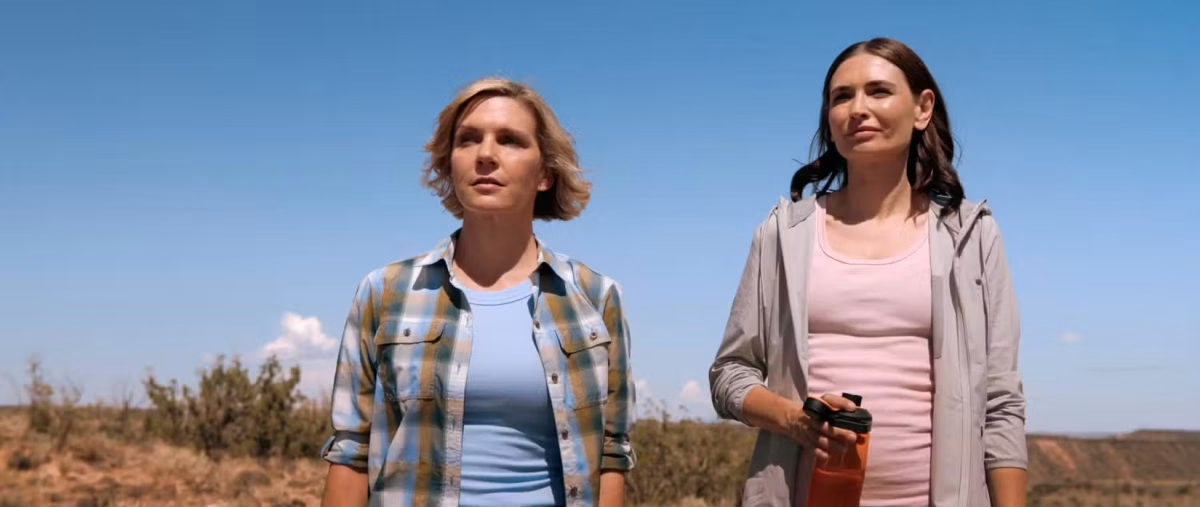
Gilligan does it again
Breaking Bad and Better Call Saul featured cinematic aesthetics that put many mega-budget movies to shame. Pluribus is no exception.
The stunning visuals with carefully selected colour palettes and compositions that non-verbally add layers of meaning to the scene. The characters behave like real human beings, each representing a philosophical position in the face of a morally ambiguous setting. Given the magnanimity of the setting and plot, it’s easy to overindulge. And yet, Gilligan does not. He goes out of his way only when the scene demands it. Moments like when all of Albuquerque leaves Carol alone remind you of the scale of the conflict. And yet, for the most part, we remain within safe walls and limited spaces. Because as magnanimous the setting is, it’s the internal conflicts that are the true driving force of this show.
Carol grieves Helen, all the while grappling with suspicion and rejection towards the Others who’ve non-consensually colonised all of Earth, minus twelve individuals. But, only two of those individuals have a problem with it. This is reflective of the real world in many ways, don’t you think?
Each episode is a piece of cinema. The slow pacing is deliberate, demanding your attention and your reflection. Because this isn’t your ordinary alien invasion story. Nor is it an action-packed hive mind adventure. This is an ordinary individual dealing with an extraordinarily horrific dystopia, challenging them both morally, ethically, and personally.
That is why I loved Pluribus. The ideas it presents and the manner in which it presents them engaged with me days after the episode aired. And that’s the mark of a good story. Expected from Gilligan, and the meeting of expectations was much appreciated.
A Morally Complex Post-Apocalypse that’s equal parts Utopian & Dystopian

What if the villains were nice people? What if the hero were a grieving antisocial curmudgeon? A virus that makes everyone happy and complacent plagues the whole world, with only twelve individuals left with free will. Will they save the world, or become complacent themselves?
While the Hive Mind concept isn’t new for sci-fi, Gilligan’s exploration of the same leaves you with many reflective questions. Every single episode presents moral dilemmas that make you question your own personal outlook to life. From Koumba’s (Samba Schutte) complete acceptance to Manuosos (Carlos-Manuel Vesga) completely rejecting the Others, Pluribus gives you the full spectrum of human reactions to a post-apocalyptic event like this. Throughout, we never really learn the Others’ true intentions. Are they just mindlessly spreading the Joining because it makes them happy, or is there a sinister goal we don’t know about.
The extreme vegan ideology of the Others, the community-centric approach that eventually leads to the world seeming like a better place, all hints at them being the good guys. And yet, we only see what they show our free-thinking characters. As much as I’m inclined to believe them, I can’t help but feel a little cautious. Is this something to do with humanity’s flaw at trusting others, or does it say something about humanity’s potential for good if we came together as a community? Is a utopia worth shedding away nearly every sense of individuality?
Season 1 is mostly set up, but it also goes through an important emotional arc for Carol. From rejection, to abandonment, to acceptance and indulgence, the finale reminds us that no matter what you say, this is a foreign entity that’s invaded our world. Irrespective of what their intentions are, we need more agency in the matter, no?
Pluribus Season 1 Ending Explained
Carol & Manuosos don’t get off on the right foot. In fact, their meeting in the finale results in complications arising between Carol and Zosia, as well as whatever Carol is planning (or not). After Zosia reveals ‘everything’ to Manuosos because he asks her, Carol drags her away. But that only leads to Manuosos asking someone else to join him. In his experiment, he triggers the Others to have mass fits. In the middle of them, he brings his radio and tunes it to the unknown frequencies, which emit a strange noise. He then brings the radio close to the male Other, and begins talking to ‘Rick’, saying reassurances and encouraging words to ‘Rick’.
Carol stops him, but once the Others come back to their senses, they tell Carol that they have to leave. The Others abandon Albuquerque once again, leaving Manuosos and Carol alone. Manuosos claims he understands a lot more about the Others, and the work can now begin. But, Carol drives away as he asks her ‘do you want to save the world, or get the girl?’.
Carol joins Zosia and the two travel the world together. During this time, Zosia reveals to her about Kusimayu (Darinka Arones) who joined the Others. She also reveals that the Others have found a way to extract Carol’s stem cells from her frozen eggs allowing for a painless Joining if Carol wants. The virus would become ready within a month. Remembering the gravity of their situation, Carol returns to Albuquerque along with a crate that she claims contains an Atom Bomb. She tells Manuosos she’s ready to help him save the world.
The way I see it, Carol can’t help but consider the world before the Joining, because those people and their memories haven’t gone away. The fact that everything can go back to how it was before. Whether you consider this post-apocalyptic world as a utopia or dystopia, it’s important to remember that none of the Joined humans (except Kusimayu) consented to the Joining. But in the same spirit, there’s no way of knowing whether those same humans would consent to the undoing of this phenomenon.
Only Season 2 will answer our questions, and I can’t wait for it to come.
Is Pluribus Season 1 Worth Watching?

Yes. It’s slow, but deliberately so. Meditative and thought provoking, Gilligan’s filmmaking style beautifully realises this complex post-apocalyptic story with layered characters and stunning visuals. It’s very different from Gilligan’s previous work, but it’s almost as good, with potential to be just as iconic.
Will there be a Pluribus Season 2?
Yes. Gilligan has started that he doesn’t yet know how many seasons, but there might be at least 4. But, the show might go on longer if Rhea Seehorn wants. And honestly, I’m looking forward to seeing how this story develops. Season 1 was absolutely beautiful, and I trust Gilligan to keep delivering this quality of story.
In Conclusion:
Pluribus Season 1 is a visually stunning, meditative and poignant show. Vince Gilligan has delivered yet another brilliant experience, and I seriously can’t wait for season 2.
Also check out:
- The Great Shamsuddin Family (2025) | Film Review
- Top 10 Books of 2025
- Top 10 TV Shows of 2025
- Top 10 Movies of 2025
- Last Night in Soho (2021) | Edgar Wright | Film Review
- Long Story Short Season 1 | Raphael Bob-Waksberg | Series Review
- Predator: Badlands (2025) | Dan Trachtenberg | Film Review
- Bullet Train (2022) | Brad Pitt | Film Review
- Bugonia (2025) | Yorgos Lanthimos | Film Review
- Island of the Dying Goddess
What did you think of Pluribus Season 1? Let me know in the comments below! Any other manga, anime, series, book, or movie you’d like me to review? Let me know your recommendations, and I’ll be sure to check them out.
Sign up for my newsletter and get a free ebook of Abandoned by the Gods!
Until next time!

![[Review] Predestination (2014) | Ethan Hawke | Sarah Snook | Time Travel Film | Amazon Prime Video](https://ronitjauthor.com/wp-content/uploads/2025/07/Predestination-2014-Review-by-Ronit-J-featuring-Sarah-Snook-Ethan-Hawke.webp)
![[Review] Takopi's Original Sin (2025) | A Patchwork Quilt of Pathos | Anime](https://ronitjauthor.com/wp-content/uploads/2025/08/Takopis-Original-Sin-Anime-Review-by-Ronit-J.webp)
Leave a Reply