

Playtime (1967) is a French satirical comedy written & directed by Jacques Tati. Co-written by Jacques Lagrange & Art Buchwald, with Bernard Maurice serving as producer, cinematography by Jean Badal & Andréas Winding, editing by Gérard Pollicand
and music by Francis Lemarque, Playtime is the epitome of everything that Jacques Tati had been building with his career and his character of Monsieur Hulot.
Starring Jacques Tati as the iconic Monsieur Hulot & Barbara Dennek as Barbara among several others, Playtime is a beautiful montage of a hyperconsumerist modern dystopia that looks great on the outside but is hollow and shambling on the inside.
Shot on 70mm film, Playtime is considered one of the greatest films ever made.
THIS REVIEW CONTAINS SPOILERS
Playtime (1967) Synopsis:
An incomparable spectacle.
Clumsy Monsieur Hulot finds himself perplexed by the intimidating complexity of a gadget-filled Paris. He attempts to meet with a business contact but soon becomes lost. His roundabout journey parallels that of an American tourist, and as they weave through the inventive urban environment, they intermittently meet, developing an interest in one another. They eventually get together at a chaotic restaurant, along with several other quirky characters.
Playtime (1967) Review:
Almost every cinephile friend of mine has recommended Playtime and Mon Oncle to me, whenever we discussed French cinema. Jacques Tati’s unique vision and aesthetics have spellbound the world for years, with Playtime often being listed among the greatest movies ever made. So after much delays, I finally got a chance to watch this masterpiece.
What I didn’t know is that the film doesn’t really have a clear plot or character development. Instead, the film is made up of cinematic tableaus, each constructed with extreme detail. Watching Tati’s masterpiece, I kept thinking of Roy Andersson’s films, which have been very inspiring for me. I can’t remember if Andersson has cited Tati as an inspiration, but I wouldn’t be surprised.
Right from the opening scene, to the final credits roll, I was mesmerised by Tati’s magnanimous vision. I don’t think I have any right to be reviewing a cinematic masterpiece such as this. Yet, here is an attempt. More like a post just rambling on about how much I loved the film (for the most part).

Artificial Magnanimity, Real Humanity
Tati constructed an entire fake city on a hill to film Playtime. That not only allowed him to construct his film with precision and complete control, it also added an organised artificiality to the aesthetic that perfectly encapsulates the dystopian nature of this hyperconsumerist world he’s exploring. Everything is cold and emotionless. The people almost march like subservient robots.
However, the 70mm footage with its wide and detailed frames allows every individual character to have their own individuality. After all, Tati did personally direct every single person. There are no extras, only characters. And in doing this, he’s created a chaotically complex world that, despite its artificial setting, retains the human spirit. The world is magnanimous, but its people are just regular folks. They go to work, they shop, and they engage in the inane.
Despite its artificiality, the humanity of its characters and, by extension, that of our real world shines the brightest. It’s only in the Royal Garden opening sequence where the cold rigidity of this dystopia melts away. What we get then is a celebration of humanity and chaos, all the while highlighting the exploitation of the working class, who continue to serve even as their uniforms tear and their workplace breaks down around them. This is the sequence where the film becomes colourful, and remains so until the end.
All in all, a very thought-provoking film that might not make you laugh as much—depending on your sense of humour—but will most certainly make you think.

The Best of Cinema
I found the exhibition sequence particularly fascinating. There are several ‘innovations’ on display, most of them not really serving a purpose other than resolving minor inconveniences. Has this futuristic world solved every major problem to now capitalise on the inane? Doesn’t that remind you of something from our own world. Even the apartment sequence. It’s scary how accurately Tati envisioned a world where lack of privacy has become an aesthetic choice. Each window displays a unique family living a unique life, all on display to the world thanks to their massive open windows.
Each sequence in this film is a unique short film in itself. Imaginatively detailed and profound in its character and philosophy. Few films manage to achieve this level of artistic finesse. It doesn’t just end there, though. It’s one thing to appreciate a film from the past. It’s a whole other thing to have that film stay relevant decades later. And that’s true for Playtime. From the confusing maze of cubicles in the corporate office, to the working class striving tooth and nail to keep up the facade of normalcy so their superiors (customers) stay happy hits a little too close to our reality today, no?
The only thing that didn’t work for me from the film—and this a matter of personal taste—is the humour. Apart from a few chuckles, the film didn’t evoke much from me other than reflection and awe. Playtime is a masterpiece and there’s no denying it. But it also didn’t resonate with me the same way it would have if I watched it in 1967, or even when I was younger. Also, I might not fully agree with Tati’s vision and philosophy, which explains why I didn’t rate the film a full 5 stars.
Playtime (1967) Ending Explained (SPOILERS)
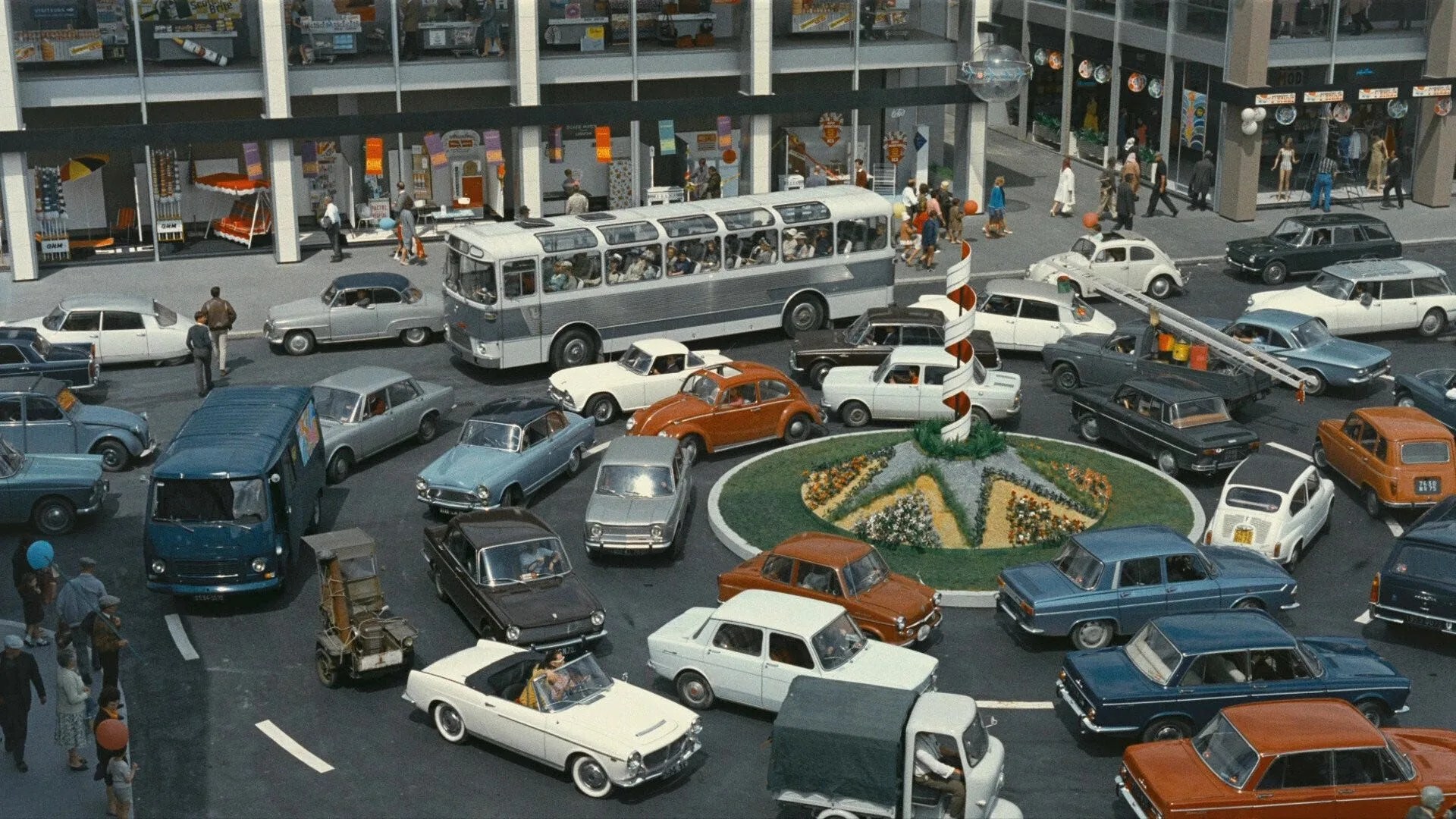
The entire Royal Garden sequence beautifully illustrates the exploitation and unsustainable legwork that undergoes the upholding of luxury. While the ignorant elite revel in haute cuisine and celebrations, the working class struggles to serve them as the restaurant literally falls apart around them. The facade of a perfect utopia comes crashing down, revealing its dystopian character in this scene. And yet, as the sun rises, everything seemingly goes back to normal. People return to work, and a semblance of order returns, perfectly demonstrated by the car carousel in the roundabout.
As this scene plays out, Hulot buys a gift for Barbara, handing it over to a passerby because he’s unable to exit the store’s strange exit. Barbara is grateful for the gift, but doesn’t know who gave it to her. The bus drives away, leaving us with a montage of this strange city that’s dystopian in its order, and yet retains the chaos that makes humanity what it is. Despite the cold opening sequences, the film takes you into the vibrant and colourful chaos of the Royal Garden sequence before bidding you farewell with a simple thought: Life is not so black and white. It’s a blend of both extremes, ultimately driven by humanity,
The start might have felt depressing, but the end is anything but. It’s hopeful that even in a dystopian state, human spirit will live on.
Is Playtime (1967) worth watching?
Yes. However, I will say that this is not a film for everyone. Where movies like Mr Bean (a character inspired by Monsieur Hulot) are just comedic set pieces after another, Playtime is much more artistic and demands a more active engagement both intellectually and emotionally. If that doesn’t work for you, then I’d avoid the film. However, if you love world cinema and French films, this one is a must watch.
In Conclusion:
Playtime (1967) is considered one of the greatest films of all time for a reason. It is just brilliantly hypnotising, it’s sets’ magnanimity matching its thematic profundity. An absolute must watch!
Also check out:
- The Chair Company Season 1 | TV Review
- Sentimental Value (2025) | Film Review
- A Knight of the Seven Kingdoms Season 1 | TV Review
- Not a Book Bingo Card | r/Fantasy | Mini Reviews
- Fallout Season 2 Review
- Crayon Shin-chan Spin-Off | Review | All 4 Volumes Ranked
- Island of the Dying Goddess
What did you think of Playtime (1967)? Let me know in the comments below.
Sign up to my newsletter & get a free copy of Abandoned by the Gods. Is there any movie, show, or book you’d like me to review? Drop your recommendations in the comments below.
Until next time!

![[Review] Predestination (2014) | Ethan Hawke | Sarah Snook | Time Travel Film | Amazon Prime Video](https://ronitjauthor.com/wp-content/uploads/2025/07/Predestination-2014-Review-by-Ronit-J-featuring-Sarah-Snook-Ethan-Hawke.webp)
![[Review] Takopi's Original Sin (2025) | A Patchwork Quilt of Pathos | Anime](https://ronitjauthor.com/wp-content/uploads/2025/08/Takopis-Original-Sin-Anime-Review-by-Ronit-J.webp)
Leave a Reply