

Flow (2024) is an Award-Winning animated film from Latvia. Written by Gints Zilbalodis & Matīss Kaža, and directed by Zilbalodis, the film was produced over a period of five-and-a-half years with a budget of about €3.5 million, using only Blendr, a free and open-source software.
Flow premiered at the 2024 Cannes Film Festival, and won the Academy Award for Best Animated Film, becoming the first Latvian Academy Award winner.
Flow is now streaming on Amazon Prime Video.
THIS REVIEW CONTAINS SPOILERS.
Flow (2024) Synopsis:
Cat is a solitary animal, but as its home is devastated by a great flood, he finds refuge on a boat populated by various species, and will have to team up with them despite their differences.
Flow (2024) Review:
I always celebrate wins like these. The very existence and subsequent appreciation of artworks like Flow are major victories for all artists across the globe. And this is increasingly true for the visual arts, a medium that’s under threat because of AI image generators and artwork. However, Flow’s victory is two-fold. Not only does it prove that human creativity will always surpass that of AI-art, it also won major awards, beating films made by mega-corporations with bloated budgets.
Flow is a visual masterpiece. This film didn’t win only because it proves a point, but it won because it proves its point in the most unquestioningly stellar way. At the end of the day, Art is a reflection of our zeitgeist, a documentation of all that exists for the present and the future to reflect upon, learn from, take inspiration from, and more.
Survival against all odds

The more you think about it, the more it becomes apparent that Flow is a dystopian film. Underneath the visual splendour and natural beauty of Flow’s setting lies a dark and deeply profound suggestion: the world has ended. What cataclysm has caused the world to end? We don’t know. And the makers don’t bother to shed light on it. Because, the reasons may vary, but the truth remains constant: we’re doomed. Maybe because humanity has ignored the ecological time bomb that megacorporations have dropped on us as a result of their greed. Or maybe because humanity has failed to identify that money isn’t going to buy you survival when nature finally breaks.
There are no humans in this world. There are residual human paraphernalia, but people themselves are nowhere to be seen. Nature has reclaimed the land. Houses and societal abodes are overgrown with grass, moss, and plants. Amidst all this, we experience frequent earthquakes, where water levels rise as hordes of animals attempt to find safer ground. The environmental message of this animated film is loud and clear. And the makers hammer in the point through the eyes of a single black cat.
Visual Storytelling at its finest
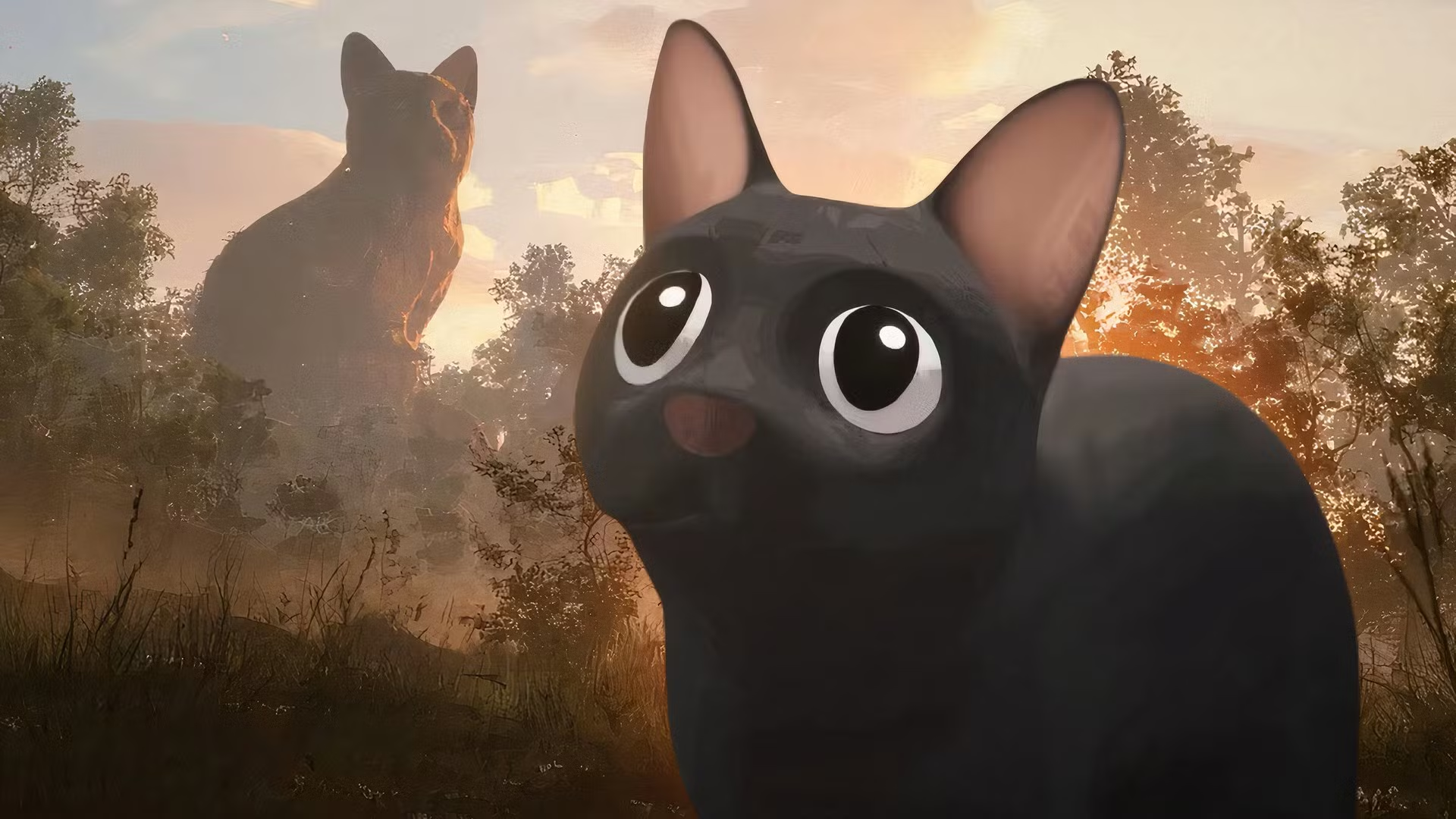
Flow features zero dialogues. Flow transcends the need for exposition, establishing the world, conflict and characters purely through visuals. The cat is our clear protagonist. The dog, capybara, and lemur slowly join in on this journey of survival, each one having its own unique backstory. The lack of dialogue leaves a lot open to interpretation, but the filmmakers have made creative use of these animals’ individual traits. The dog comes from a pack, while the capybara has been navigating the waters in a boat. The lemur has the most interesting visual gimmick: hoarding goods and having established some form of trinket economy and social hierarchy.
As the film progresses, we know that the group is looking for survival. They make their way to the highest point of the land so they can finally escape the constantly rising water. While the cat struggles to survive by itself, when it begins to offer aid and accept it in return, slowly the progress of the journey becomes smoother. They travel through ruins, and come across different groups of passing animals, all headed towards safer lands.
While the story itself isn’t all too unique or mind-blowing, the fact that the makers told this story with an ‘all show, no tell’ approach is worth more accolades than they’ve already earned.
Flow (2024) Ending Explained (SPOILERS)

When the group reach their final destination, the secretary bird and the cat end up in some kind of labyrinth-like ritual room. The carvings seem to be magical, suspending gravity and opening a portal to the stars. While the secretary bird vanishes in the stars, the cat falls back to the ground. The makers don’t explicitly say this, but possibly some (if not all) humans probably found a portal to the heavens, and left our rotting world behind. The birds might have knowledge of this, which is why the secretary bird was able to leave our world behind.
Since the cat wasn’t able to leave, it returns to a kind of amphitheatre, where a group of lemurs is admiring the broken mirror. Another round of earthquakes shake the world, making all animals flee. Our group reunites and saves their labrador retriever from falling down the valley. Everyone thinks the water will rise again and drown them all. But, the water recedes instead. The cat finds and comforts a mutated whale that’s beached on the mountain, and then the group looks at their reflections.
The ending remains open to interpretation. I interpreted it as this—
The secretary birds were possibly the last of the predatory species, given how they try and hunt the cat. Their leaving probably put the world back in balance, which is why the waters stopped receding. Nature has fully claimed the earth, and now the survivors are left to reflect upon what kind of new world they want to create.
An after-credit scene shows a whale surfacing from the ocean, suggesting that life might be going back to normal.
Is Flow (2024) worth watching?
Yes. The only reason you shouldn’t watch Flow is because you don’t like silent, non-expository films with clear plots and conclusions. If you hate open endings or interpretive storytelling, you might not appreciate this one.
However, if you don’t mind those things, you will absolutely love Flow.
In Conclusion:
Flow (2024) is one of the most visually stunning films I’ve watched in recent years. It is a masterpiece. It is a testament to human creativity and artistic skill.
Also check out:
- Coherence (2013) | Film Review
- Common Side Effects (2024) | Series Review
- Fahim (2019) | Film Review
- Black Mirror Season 7 Review | Episodes Ranked
- Island of the Dying Goddess
Have you watched Flow (2024)? What did you think about this film? Let me know in the comments below, along with any film recommendations you’d like me to watch/review.
Subscribe to my newsletter, and grab a free copy of my fantasy anthology, Abandoned by the Gods! Until next time!

![[Review] Takopi's Original Sin (2025) | A Patchwork Quilt of Pathos | Anime](https://ronitjauthor.com/wp-content/uploads/2025/08/Takopis-Original-Sin-Anime-Review-by-Ronit-J.webp)
![[Review] Why the Poor Don’t Kill Us: The Psychology of Indians by Manu Joseph](https://ronitjauthor.com/wp-content/uploads/2025/10/Review-Why-the-Poor-Dont-Kill-Us_-The-Psychology-of-Indians-by-Manu-Joseph-Review-by-Ronit-J.webp)
Leave a Reply